

Creating a product or service doesn’t guarantee an audience. It’s not a case of “build it, and they will come.” Instead, success lies in constructing it meticulously, incorporating the right features and benefits. Thoughtful development ensures that, upon launch, you’ll have something people are genuinely interested in purchasing.
This is where product concept testing comes into play. You gain valuable insights by employing a research process that collects consumer feedback throughout the development cycle. This actionable data enables you to introduce products to the market that align with consumer preferences and needs.
Why A Product Concept Test is Worthwhile
Effective market research is a valuable tool for risk mitigation. Specifically, a product concept test serves this purpose exceptionally well. There are two fundamental reasons why engaging in concept testing is a wise decision before the launch of a new product or service:
1. Efficient Use of Resources: Bringing a product to market is time-consuming and costly. This encompasses the investment of time and money in the product’s development, as well as the allocation of resources for sales and marketing. By dedicating upfront time to developing the right product, you ensure more efficient utilization of both product and marketing resources in the subsequent stages.
2. Informed Opportunity Trade-off: Introducing one product to the market inherently means not investing time in another. In environments where resources are constrained, this presents a natural trade-off that necessitates careful consideration. By conducting concept testing at the outset, you gain confidence in making informed decisions about which product to bring to market, ensuring that you make the right opportunity trade-off.

What Does A Product Concept Look Like
In essence, concept testing serves as a strategic measure to streamline resource allocation, saving both time and money and provides the insights needed to make judicious choices about where to direct efforts in a resource-limited setting.
Concept tests play a crucial role in the initial phases of product development. During this stage, a fully developed product isn’t available, nor is it expected to be. The primary objective is to gather insights that will guide the path towards a refined product. Consequently, concept ideas at this juncture typically fall into one of two categories:
Concept Approach #1: Concise & Direct
Tailored for the early stages, concise and direct concepts are brief, text-only ideas comprising 2-3 sentences. These encompass a fundamental description of the product, its advantages, and possibly details such as cost or other factors influencing purchase decisions. This approach captures initial impressions, allowing for a clear distinction between what works and what doesn’t. Essentially, it aids in separating valuable insights from less relevant ones right from the outset.
Here’s a fake example of a short and sweet concept:
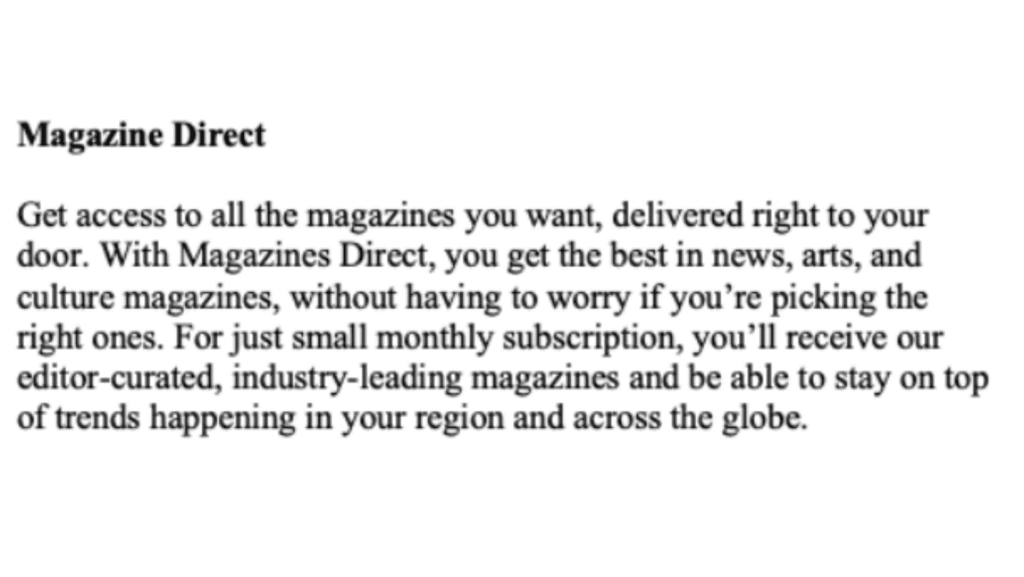
Concept Method #2: Elaborate & Comprehensive
Suited for subsequent concept refinement, the extended and detailed concept delves into greater depth. With this method, you delineate various essential product features. You also delineate who the product is for. The method’s objective is to gather profound insights into specific features and benefits for subsequent refinement.
Here’s a fake example of a long and detailed concept:

Just to clarify, concepts can incorporate visuals. For instance, this may involve packaging visuals, product images, or screenshots of a product UI. Nevertheless, you probably won’t invest time in creating visuals until you have some preliminary validation.

How To Perform A Product Concept Test With Customers
After formulating potential product ideas that may appeal to customers, the subsequent step involves testing them. Typically, there are two approaches to consider: qualitative testing conducted through interviews or focus groups, and quantitative testing conducted through surveys.
1. Qualitative Concept Tests
How It Operates: Employing a qualitative strategy for concept testing often involves appending a concept test to the conclusion of a focus group or one-on-one interview. In this method, you present a single concept to a group or interviewee and then pose a series of questions regarding who likes the idea and why, who dislikes the idea and why, and if it elicits questions or concerns.
The reading and assessment process is replicated for each concept you wish to present. Towards the end of the process, participants are prompted to select their favourite and least favourite concepts. By posing this final question, you can swiftly gauge the strongest and weakest ideas.
Suitable for:
– Instances where minimal testing has been conducted previously
– Situations demanding fundamental guidance on the appropriate next steps
– Uncertainty about the nature of feedback or the factors influencing it
– Preference for in-depth, nuanced feedback over-assessments of larger quantities of concepts
– B2B products facing challenges in obtaining sizeable quantitative samples
2. Quantitative Concept Tests
How It Operates: Employing a quantitative approach to concept testing typically involves conducting an online survey and collecting responses from hundreds of participants. In this method, participants are presented with a single concept and are usually asked a series of overarching questions about it (e.g. likelihood to purchase, likeability, believability, etc.).
This process is repeated across several concepts to collect the same data points for each one. Ultimately, participants are often requested to rank their most and least favourite concepts. Alternatively, they may be asked to rank all the concepts they observed from most favourite to least favourite.
Suitable for:
– When you require statistically significant data to ascertain the most promising direction.
– When prioritising testing numerous concepts over obtaining more profound, nuanced feedback.
– When you necessitate apples-to-apples comparisons and data across concepts to comprehend relative appeal.
– B2C products or B2B products when locating respondents isn’t overly challenging.
Next Steps
After establishing a clear direction for the types of products you intend to launch, the subsequent steps involve finalising the product itself and determining the approach for its launch.
Product Refinement
Although initial concept testing provides some description of the product you plan to launch, there are likely various features you could include, a range of benefits you could highlight, and perhaps different price points to consider. Launching with the optimal mix of these components is crucial, which is why many product managers conclude their product development cycle with something known as a conjoint or trade-off analysis. This type of research allows you to comprehend how much consumers value certain features over others, enabling you to assemble a product they will adore.
Launch Strategy Development
Once you have a clear understanding of your product, you must formulate a strategy for bringing it to market and placing it in the hands of customers. This is where launch strategy development becomes crucial. By devising a systematic approach that defines your customer focus, product criteria, messaging and value propositions, marketing tactics, as well as resource and budgetary requirements, you’ll be well-prepared to introduce your product to customers and persuade them to make a purchase.
